
A true story of Imperial Russia from the Memoirs of Julia Gudym-Lefkovich
In Imperial Russia an education could change the course of a peasant child’s life. But first he had to find a way into a classroom This true story, preserved in the memoirs of my grandmother-in-law, Julia Gudym-Lefkovich, follows one determined boy from a Russian village, through revolution, exile, and a journey neither of them could possibly have imagined.
Our Barefoot Visitor
On a warm spring day, probably in 1900, Papa and I were sitting on the verandah of our house in Fernatia, our estate in the Ukraine.
We were enjoying tea and pryaniki, a type of little honey spiced gingerbread cookie that was Papa’s favorite.
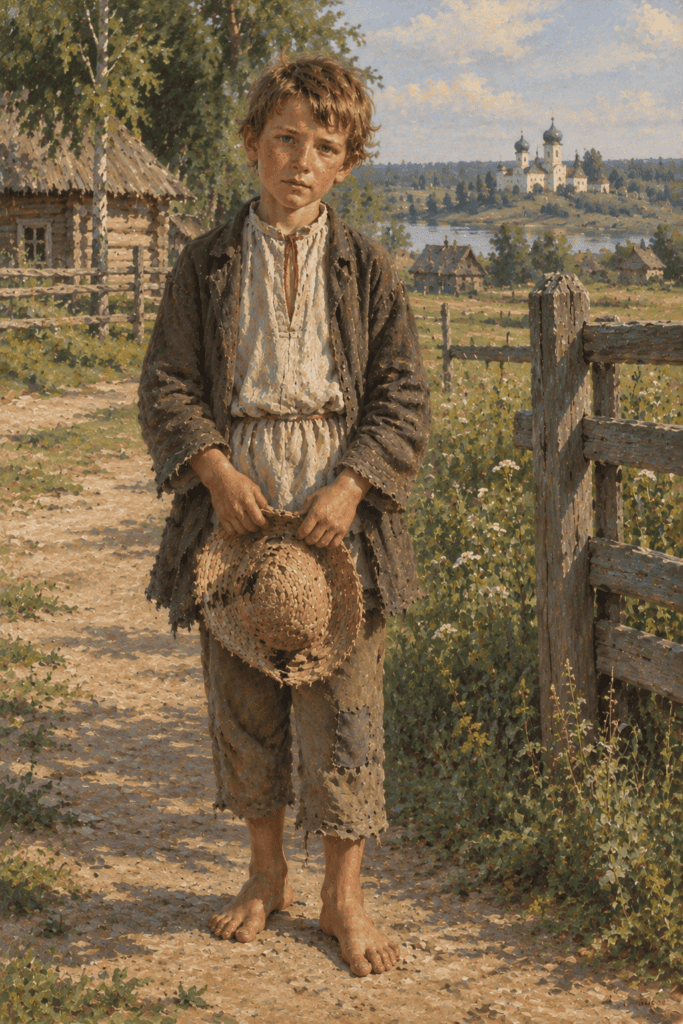
Papa and I were admiring the lilacs along the drive when a little barefoot peasant boy of about nine years old appeared and walked up to the house. He came right to the foot of the steps of the verandah, removed his little straw hat and stood quietly looking up at Papa.
“What do you want?” Papa asked him.
“I want to learn,” the little boy answered in a clear voice.
Papa smiled. “If you want to study, you must go to school.”
“I have already finished the village school,” the boy replied earnestly. “I want to learn more.”
“Where do you live?” Papa asked.
“Strymba,” the boy said, standing taller. “I walked all the way.”
Strymba was a village around six or seven versts away. A long walk for such a small boy.
“Well,” Papa said. “It is summertime now. School is no longer in session. You must come back in the autumn.”
The boy sighed and shrugged, turning his straw hat in his hands.
“Come. Sit,” Papa said. “You must be thirsty after walking so far. I have only tea for you to drink. But it is not strong because I am an old man and no longer drink strong tea.” Papa winked at him. “And I also have very nice pryaniki. Come.”
The boy gave a little smile, came up the steps onto the verandah, and Papa pushed the footstool out for the boy to sit. I poured him a glass of tea which he drank with great joy. I held out the plate of gingerbread, and he politely took only one.”
When he had finished eating, Papa told him once more to come back in the autumn if he wanted to learn more. I gave him several pryaniki for the road and the boy left.
Naturally, Papa forgot all about the little visitor.
He Came Back
But when autumn arrived, so did the boy.
Once again, he stood in front of our verandah, just as determined as before.
“I want to learn!”
This time, Papa listened more carefully.
When the boy had drunk some milk and eaten a couple soft, buttered buns, Papa questioned him.
“What is your name?”
“Pavlusha Veselovskii,” the boy answered.
“And who is your father, Pavlusha?”
“My father died last year,” Pavlusha said. “But my mother takes care of our house.”
“Do you have brothers and sisters?”
“I have four brothers, but they are all older than me.”
“Can they not help you to learn?” Papa asked.
“They are not interested in school.” Pavlusha became excited and continued in a rush. “That’s why I came to you. You are smart and you know people. I have to learn so I can help my mother and our village.”
Papa was deeply moved by the boy’s persistence. He could see a hunger for learning burning brightly in the youngest son of this small peasant family.
I found Papa’s sincere interest in Pavlusha quite moving. Our family was also small, and Papa had only two daughters, my sister Kira and myself, and a son, Tosya. Perhaps that’s why he was inspired to take Pavlusha under his wing. What he said next surprised me.
“Pavlusha. If you are really serious about learning and working very hard at it, I will help you.”
Pavlusha’s eyes widened and his little face looked as grave as a schoolmaster’s.
Papa continued. “Soon, I am taking my family to our house in Kiev for the winter. If you want to go to the next level of school, you may come with us, live in our house, and learn. You must get permission from your mother. It is also important that your brothers know about it and where you are. Will you do that?”
Pavlusha jumped up and to our surprise rushed to Papa, grasped his hand and kissed it.
“Thank you! Thank you!” he cried. “I will be the best student ever. I will work so hard. I will make you proud. Thank you. I knew you would help me. My mother didn’t believe me. But she will now.”
He ran down the steps, turned, smiled, waved and was gone.
Papa Feeds Pavlusha’s Hunger for Learning
When we left for Kiev, Pavlusha came with us.
Papa enrolled him at a school in Kiev. Pavlusha lived with us as one of the family. He was a quiet, respectful boy, almost invisible around the house because he devoted himself entirely to his books. I scarcely remember seeing him at play. He was always studying. And he completed his studies with excellent marks.
At this point, Papa sat down with Pavlusha to talk about his future. Papa believed education should be useful, and it seems Pavlusha felt the same.
“Pavlusha,” Papa said one morning, “you have finished your studies with very high marks. This is a great achievement and will improve your life. What do you want to do now?”
Pavlusha thought for a moment and then answered Papa.
“If you please, sir. I should like to learn something useful for my family and my village. The reason I came to you at Fernatia three years ago was because you have a really good farm. Your land always produces good crops. I have seen it. Our village farm is bad. The crops are small and sometimes dry up and die before harvest time. Nobody knows what to do. And they don’t want to learn about farming. Our soil is good, like yours, but something isn’t being done right. If I could learn how to farm well, I could go back to my village and help everyone. Our village could be as successful as your estate farms at Fernatia.”
He stopped, unable to ask for even more help from Papa.
“I’m proud of you, Pavlusha,” Papa said, and smiled. “You are the kind of young man Russia needs. The school you’ve just finished so successfully isn’t one to give you what you need for your farm. How would you like to go to an agricultural school? One where they teach you about the very things you want to do in your village.”
Pavlusha’s face slowly brightened into a wide grin. “It would be like a dream,” he said.
Papa took up the project. He arranged for Pavlusha to attend an agricultural school, established by the wealthy philanthropist Khanenko, in Chernigov Province. This was around a couple of days’ travel from our house in Kiev and even farther from our estate in the countryside. Pavlusha was to live at the school.
The Trouble with Beautiful Handwriting
It was a three-year course. During Pavlusha’s final year, the revolutionary unrest of 1905 reached even the school. Students were circulating handwritten leaflets criticizing the administration.
Only one student was expelled.
Our Pavlusha.
He was accused of writing the leaflets.
Papa was furious.
Pavlusha came home to us and Papa confronted him.
“Pavlusha! What were you thinking? How could you have done such a foolish thing as take up with the revolutionary students? Do you understand that you’ve destroyed everything you’ve worked hard for these past years? After all the effort I’ve put in to make sure you got the learning you wanted so badly. I am bitterly disappointed in you.”
“Please!” Pavlusha pleaded. “Please listen. I never meant to be with those students. I didn’t write the leaflets myself. I tried to tell the headmaster that, but he didn’t listen. The students who wrote them asked me to do the final copy because they liked my writing. They said it was more beautiful than theirs. Like calligraphy, they said. And it is more beautiful than theirs. I learned how to write like that at the first school. I didn’t see anything wrong in copying it for them. I didn’t even pay much attention to what the leaflets were about. Just tried to make the copy look good.”
Papa gave him his firm, regiment commander look. “Pavlusha. Do you expect me to believe you didn’t know what you were writing? That you had no connection to those students?”
“I didn’t. I swear!” Pavlusha pleaded. “I guess it was stupid. When I told the headmaster, he asked those students about it, and they said they didn’t have anything to do with the leaflets. They didn’t say they had asked me to copy them. They just lied.”
Papa Takes Up the Fight
For a while, Papa sat and thought while Pavlusha sat in nervous anticipation.
Finally, Papa spoke.
“Pavlusha. I have always known you to be a hard-working young man, and an honest one. I’ve heard your side of this story, and I have to say that I am inclined to believe you. But the accusation against you is a very serious one. Therefore, I am going to investigate this further. You will remain here with us and continue to study on your own. I will go and speak to Mr. Khanenko, get to the bottom of this, and plead your case.”
And Papa did exactly that. I don’t know what he said to Mr. Khanenko, but I’m sure it included a full history of his knowledge of Pavlusha’s character and seriousness for his studies. Papa could be very eloquent with persons of authority. Whatever arguments he gave in favor of Pavlusha, they worked.
Pavlusha was readmitted, completed his studies, and graduated successfully with high marks.
An Even Bigger Dream
However, Pavlusha was not one to rest on his laurels. His ambition continued to grow. He formed a desire to study viniculture in Kishinev. This school, the Bessarabian School of Viticulture and Winemaking, was quite new. It had only been founded eleven years previously in 1894. I was always amazed at how Papa kept up with recent technology developments in Russia. At this time, 1905 it was, Papa’s health was, unfortunately, fading fast. However, he took a particular interest in this new desire of Pavlusha’s and wrote to someone he knew who had contacts with the school.
The Bessarabian School of Vitculture was small, only 40 students. It was very specialized, focusing on training vineyard supervisors, cellar managers, and professionals to modernize wine factories and combat crop diseases such as the terribly destructive phylloxera grape-pest that was sweeping through European and Russian vineyards at that time.
Why Pavlusha formed such a passion for viticulture, I don’t know. I suspect Papa talked to him of wine and how Russian wine produced mostly in the Crimea was good enough to rival the best wines of France at that time. And, no doubt, Papa also shared tastings with young Pavlusha in the evenings in his library. My sister Kira and I were not great wine enthusiasts and weren’t much interested in the differences in grapes, tastes and vintages of wine. Pavlusha eagerly drank in everything Papa offered, both in wine knowledge and the wines themselves.
Sadly, Papa died at the end of 1905, before he could see how far Pavlusha would go.
A Whole Family Enterprise
Admission to the Bessarabian School of Viticulture required passing examinations equivalent to the sixth year of a real school. So, Pavlusha came to our estate at Fernatia to prepare.
It became something of a family enterprise. Our Fraulein taught him German. I taught him French. My brother Tosya coached him in mathematics. Everything else Pavlusha mastered himself.
The Boy’s Dream is Fulfilled
In the autumn he passed the examinations, entered the School of Viticulture and Winemaking, and graduated four years later.
By this time, I was at the university in Saint Petersburg, and I never learned whether Mama continued paying his expenses or whether he earned a scholarship. I have always suspected the latter. He was certainly capable of it.
After Pavlusha graduated, he found work as a specialist in viticulture and related agricultural enterprises. At one point he even got to work in the vineyards of the Crimea.
Our lives drifted apart. I married. Russia joined in the World War.
Then came the Bolshevik Revolution.
The Old World Vanished
In October of 1919, my husband George and I were dodging the Bolsheviks in an effort to stay alive and somehow get out of Russia. Wanted posters bearing George’s photograph had appeared in the region around Kiev, so for a time we made our way to Odessa.
One day, I was returning to the house where we were hiding when I saw a man coming toward me along the street.
I knew him before I quite believed I knew him.
Pavlusha.
Nearly twenty years had passed since the barefoot little boy had appeared on our porch at Fernatia and announced that he wanted to learn. That boy was gone. The man walking toward me was older, of course, and carried himself with the confidence of someone accustomed to making his own way in the world.
I lowered my eyes and kept walking.
How he recognized me I will never know. I was dressed in the plainest clothing I could find, my hair hidden beneath a scarf. Fear and the hardships of the previous months had altered me, and I bore little resemblance to the young woman he had known at Fernatia.
Yet, as we drew abreast, he stopped.
“Julia?”
Friend or Enemy?
My heart seemed to stop with him.
I looked at his face but said nothing.
Those were dangerous days. A familiar face was not necessarily the face of a friend. My husband George was being hunted, and I was as well. The Bolsheviks knew if they captured me George would come to my rescue. They would have both of us. And what would happen to our little son and baby daughter? There was so much at stake.
I did not know where Pavlusha’s loyalties lay now, or what the Revolution had made of the boy my father had once helped.
And another thought came almost immediately: if Pavlusha was not with the Bolsheviks, then recognizing me might place him in danger as well.
He must have seen something of this in my expression.
He did not ask where I was living. He did not ask about George. He did not even ask why I was in Odessa.
Instead, he said quietly, “I have often thought of your father’s library.”
For a moment the street around us disappeared.
“I remember someone who was supposed to be studying French,” I replied.
He gave me the faintest smile. “I was much better at mathematics.”
That was Pavlusha. Careful and clever.
Part of me wanted to embrace him. Another part wanted to run away from him.
His eyes glanced past my shoulder.
“Don’t stop here,” he said softly. “Keep walking.”
He moved on without another word.
I did the same.
After several steps I heard his voice behind me, scarcely louder than the sounds of the street. “There is a little café two streets over. On the corner. Ten minutes.”
I kept walking and did not look back. For the next ten minutes I argued with myself.
What did I really know about him now? Almost nothing. Russia had changed. People had changed with it. Families had been divided between Reds and Whites. Old friendships had become dangerous. A careless word could mean arrest. Sometimes considerably less than a careless word was enough.
But I kept remembering the barefoot boy on our porch.
I want to learn.
So, I went to the café.
The Last Time I Saw Pavlusha
Pavlusha was already there at a small table in the back. He rose when he saw me, but I motioned for him to sit. Neither of us spoke for a moment.
Then he said, “My brothers are with the Bolsheviks.”
I felt myself stiffen.
“But I am not,” he whispered.
Perhaps he saw that I was still uncertain.
“I want to leave Russia,” he continued. “If I can get to France, I may be able to find work there. In the vineyards.” He lowered his voice further. “There are also vineyards in America. Far to the west, in California. Near the Pacific Ocean.” A tiny shrug. “Who knows?”
Vineyards.
I could almost hear Papa’s voice again. Papa had wanted Pavlusha to learn agriculture so that one day he might improve life for the people of the countryside. Pavlusha had studied agriculture, then viticulture, and had even worked among the vineyards of the Crimea.
And now, after all those years, the education that had begun on our porch might offer him a life he only dreamed of as a boy. If he could survive long enough to escape from Russia.
We talked for a little while. Mostly, I praised his determination and encouraged him to hope for the future he so wanted. There was much we could not safely say, even there in that tiny café. I told him very little about George and nothing that could endanger us or Pavlusha if he were questioned later. He was equally careful.
When at last we rose to leave, I don’t remember that either of us said goodbye.
Sadly, in those days people had learned not to.
A Letter from An Exile in Paradise
The Revolution scattered us all, and Pavlusha disappeared into the great silence that swallowed so many lives.
George and I, along with our little son and daughter, managed to escape into exile in Yugoslavia. My life was filled with raising my children and working many different jobs to survive.
Sometimes, when the morning light was just right, I would remember Fernatia and a little nine-year-old boy. I would imagine him a young man now, walking through rows of vines somewhere in Burgundy or Bordeaux, examining the grapes with the seriousness he once gave to his schoolbooks.
It was a fantasy because there was no way I could know if he survived the Revolution.
Then one day, I believe it was 1938 or around that, I received a letter with a postmark I didn’t recognize. The envelope was worn on the edges, the address barely discernable. It had obviously passed through many hands. How it got to me I couldn’t imagine. I opened it and quickly looked for the signature.
It was from Pavlusha!
Dear Julia,
Blessings on you. I hope you and your family are alive and well and that you get this letter.
I write to you from paradise. Yes! From the golden American state of California. I want to tell you about my journey to this place because, of all people, I know you will rejoice with me.
Do you remember that day in Odessa in 1920 when, in spite of the horrors of the revolution and the uncertainty of both of our futures, you gave me encouragement and hope that I might realize my dream of working in the vineyards of France? I also mentioned America. That was a complete fantasy. I want to tell you now, Julia. Fantasies can come true.
After I escaped Russia by the grace of God, I was able to get to France. For a time, I worked in the vineyards of Bordeaux. There I met a fellow Russian. You might know of him. His name is Andre Tchelistcheff. Your father, rest his soul, may have known Andre’s father because he was Russian aristocracy and the chief justice of the Russian Imperial Court.
Andre told me his own amazing revolution story.
Can you believe it? He was only 17 when he fought with the White Army against the Bolsheviks. God must have been watching over him because he told me his unit was machine-gunned and he was left for dead on a Crimean battlefield. This was in the cruel winter of 1921. By some miracle he survived and escaped to Yugoslavia. Did you ever meet him or his family?
Like me, Andre had a deep desire to make a career for himself in viticulture. He began in Czechoslovakia and eventually ended up in France. And that is where our paths crossed. I worked in the vineyards with him for a time in Bordeaux. We became friends. He was glad to meet a fellow Russian, so far from home, with the same passion for grapes and wine. And this is where my miracle began.
Andre is a genius with wine and viticulture. He had invitations from winemakers all over the world to work with them to create great wines. I was so proud to know someone so talented. Then one day, around a year and a half ago, a man came from California, from a place called Napa Valley. He was the owner of a winery called Beaulieu. His name was Georges de Latour. He was looking for a new winemaker. Andre talked to me about it, as he sometimes did. This Georges de Latour wanted someone who was, he said, cosmopolitan but with a scientific background. That certainly was Andre.
Andre was offered the position of vice president and chief winemaker at Beaulieu Vineyards! It was an offer out of a dream. Andre is only 38 years old!
And then, my miracle happened. Andre asked me to come with him to America. To this Napa Valley, and work for him there. I think it may have been because we shared so many connections with Russia. Or maybe it was just because it’s good to be able to speak your native language at times when you are so far from your homeland.
I have been here in this beautiful place for half a year now. I write not just to tell you what happened to the little boy who came to Fernatia so boldly asking to learn. I want you to know how wonderful a place America is, and especially California. If you ever get a chance, this is the place you should come to. It reminds me of your estate of Fernatia. Such good soil. Such beauty.
God Bless You! God bless and keep your family.
Yours forever in gratitude and affection.
Pavlusha
The Boy I Never Forgot
As I read his letter, my heart eased a bit. Pavlusha’s story was a small light in the darkness for me. My brother Tosya, who had tutored Pavlusha in mathematics, was dead. He was killed fighting the Bolsheviks in the winter of 1921. The same winter Pavlusha’s friend Andre Tchelistcheff was spared. So many friends and family members were gone, either to heaven or scattered around the globe. So many broken dreams.
And yet, as I stood in exile in the small vegetable garden we shared with neighbors in a tiny village in Yugoslavia, I was sitting once again on our verandah at Fernatia. The sun was shining, the lilacs glowing soft purple, and a barefoot nine-year-old boy was standing in front of Papa.
Papa asks him what he wants.
And Pavlusha answers.
“I want to learn.”
Author’s Note.
This story is from the memoirs of Julia Gudym-Lefkovich, my great grandmother-in-law.
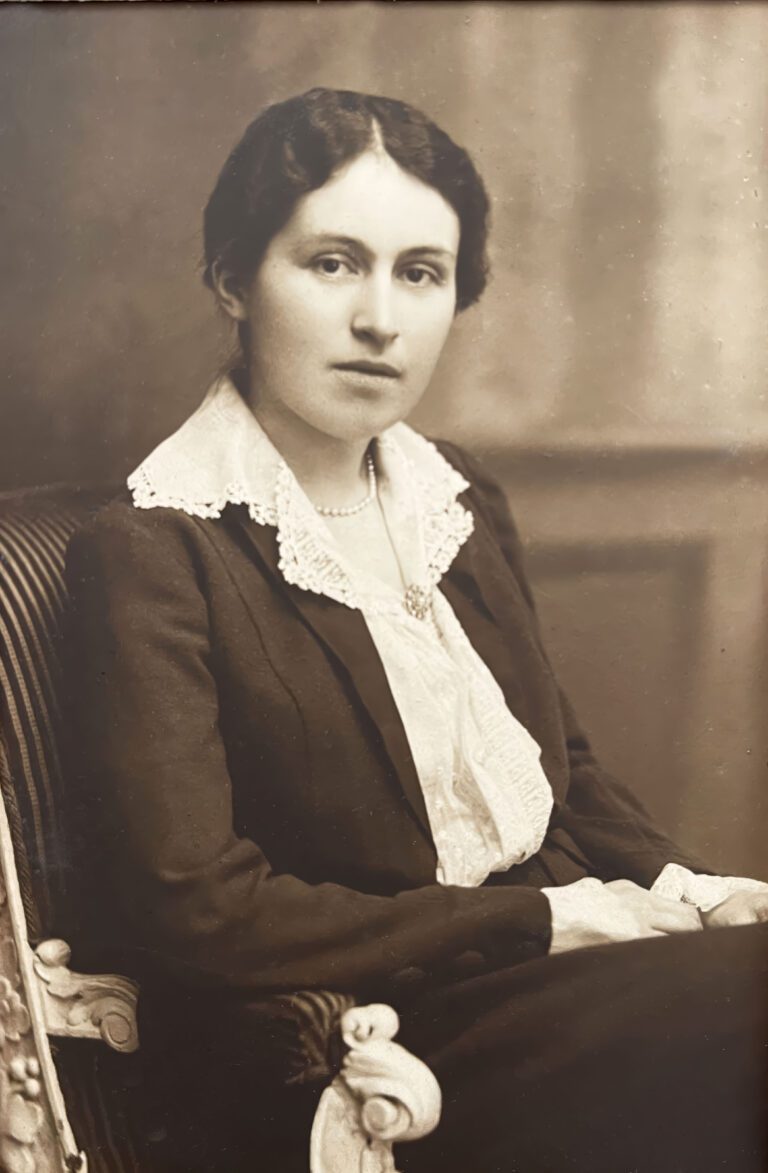
She was born in Imperial Russia at the sunset of the nineteenth century, in 1887 in Kiev. Her childhood was blessed with a country life on her parent’s estate in the Ukraine. Seeing how her mother cared for the village women around the estate, Julia yearned to go to university and train to become a doctor. Her mother refused to let her attend the University of Saint Petersburg (too many long-haired revolutionaries, and proper young ladies married a respected neighbor).
So, Julia waited until she was of legal age (21). During those three years (18 to 21) she taught herself Latin, Greek, higher Math, etc. All the subjects she had not learned in finishing school and needed for admission to university at that time. Then she left home and moved to St. Petersburg to go to university.
After graduating in Biology, she did marry that neighbor, and she set up a free clinic near their farm. Also, her knowledge of languages (she spoke perfect French, German, and English) helped her make a living in exile. Her knowledge of English saved her family’s life when they were on the run from the Bolsheviks.
Her memoirs are a treasure of stories from that time.
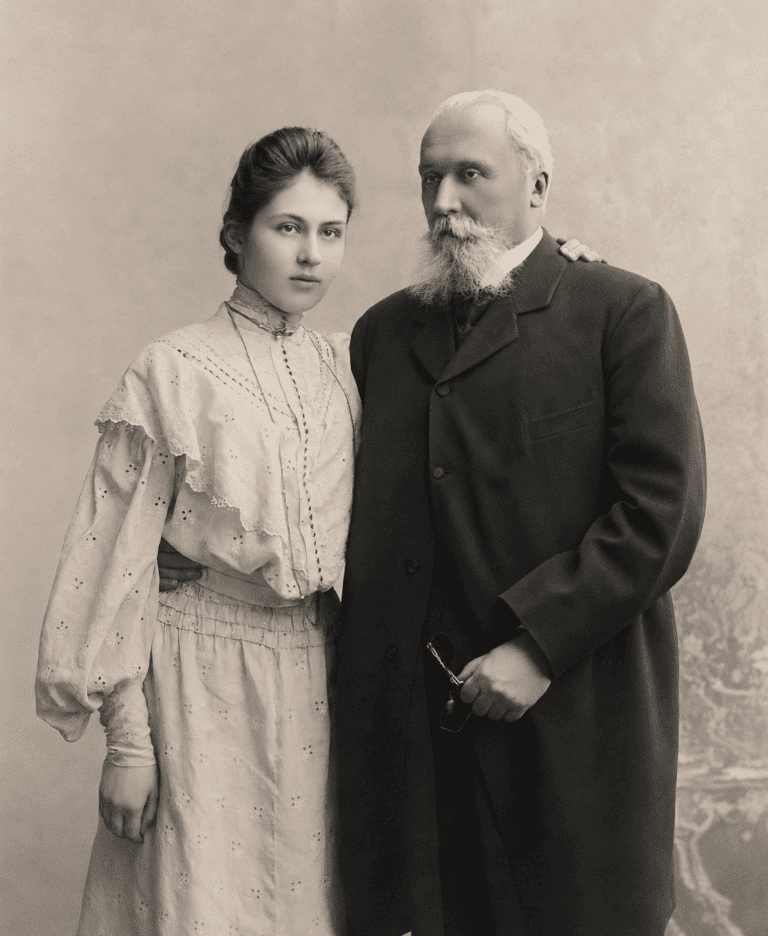
Here is a photo of Julia with her father, the man who helped little Pavlusha to learn.
Pavlusha would have been glad to know that Julia did come to America. Unfortunately, she never lived in California. But her grandson, George Kovach, moved to California to attend UC Berkeley. He lives there still, has a life-long passion for the history and enjoyment of wine, and regularly visits Napa Valley.
Julia Gudym-Lefkovich wrote down her memories of her life in Imperial Russia and in exile for her children and grandchildren. So that they would know where they came from, who their ancestors were, and the dramatic history of their lives.
There will be more stories to come from her remarkable memoirs.
Julia George

